Gingival recession: why is a filling not always the right solution?
Writes: Dimitar Nacevski, DMD, Specialist in Oral Surgery
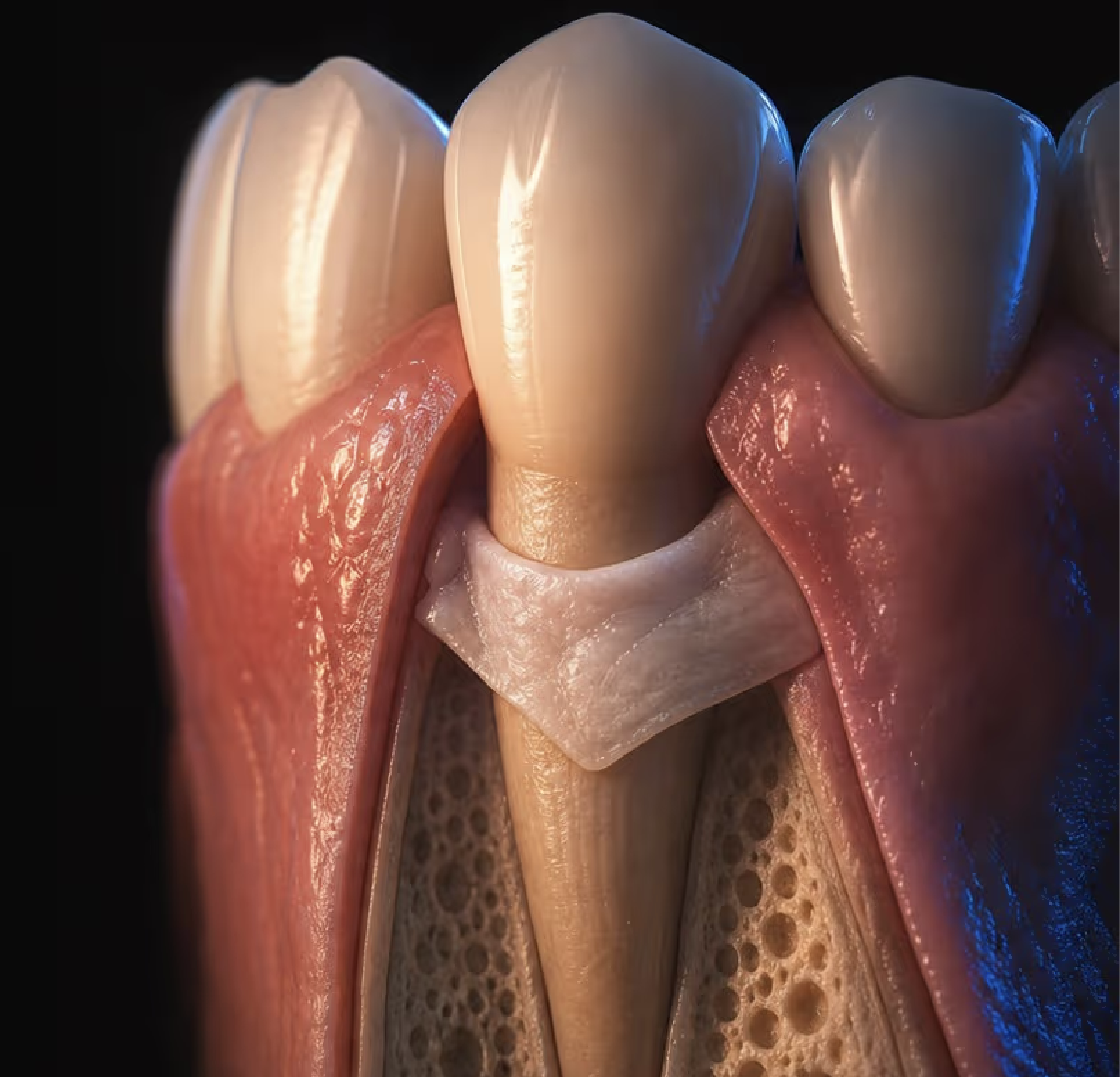
Gingival recession is not merely an aesthetic concern. As the gum recedes, part of the root becomes exposed, so the tooth may appear longer, become sensitive and be more susceptible to decay or damage around the cervical area. The key question is therefore not only how to cover the exposed surface, but why the recession developed and how to prevent it from progressing.
A filling treats the consequence, but not always the cause
In clinical practice, an exposed root is often immediately covered with composite. A filling is justified when there is decay or genuine loss of tooth structure, but it does not restore the gum, increase tissue volume, or correct the position of the tooth or its bony support.
If placed without a prior assessment, it may simply mask the problem, while a poorly contoured restoration can make oral hygiene and future surgical treatment more difficult. When recession is accompanied by damage to the cervical part of the tooth, the best result is often achieved through a combined restorative and periodontal approach.
Why does gingival recession develop?
There is usually no single cause, but rather a combination of factors:
• thin gingiva and a thin facial bone plate;
• a tooth positioned too far towards the lip or cheek, sometimes with a bone dehiscence or fenestration;
• plaque, calculus, chronic inflammation and untreated periodontal disease;
• aggressive brushing, a hard-bristled toothbrush and forceful horizontal strokes;
• crowded teeth, a high frenal attachment, a shallow vestibule or muscular pull;
• poorly contoured fillings and crowns, smoking, oral piercings and repeated mechanical trauma.
Brushing should not be less frequent, but performed correctly: with a soft toothbrush, controlled pressure and a technique tailored to the patient.
Orthodontic treatment can either help or increase the risk
Orthodontic treatment is not, in itself, a cause of recession. The risk increases when a tooth with a thin periodontal phenotype is moved outside its bony envelope, especially with excessive proclination or expansion, inflammation, or inadequate oral hygiene. Conversely, carefully moving a malpositioned tooth into a more favourable position may improve the prognosis. Before treatment, the position of the root, the thickness of the gingiva and bone, any existing recessions, and the planned direction of movement should therefore be assessed.
Clinical assessment and the role of CBCT
Two recessions of the same depth do not necessarily have the same prognosis. The examination evaluates the width and depth of the defect, interdental support, the thickness and width of keratinised gingiva, tooth position, inflammation, the frenum and vestibule, and any damage to the tooth structure.
CBCT is not required for every recession. It is used selectively when three-dimensional information may change the treatment plan - for example, in cases of multiple recessions, significantly malpositioned teeth, or before combined orthodontic-periodontal treatment. It can help assess root position, the buccal bone plate, and possible dehiscences or fenestrations.
CTG or FGG?
CTG (connective tissue graft) is most often selected when the aim is root coverage, increased tissue thickness, and a natural aesthetic result. It is particularly predictable in appropriately selected cases in the aesthetic zone and can be used for one or several adjacent recessions.
FGG (free gingival graft) is primarily used to increase the width of keratinised and attached gingiva. It is useful where the tissue is very thin, the vestibule is shallow, or there is pronounced muscular or frenal pull, particularly in the lower anterior region; however, its colour and texture may differ from the surrounding tissue.
An individual treatment plan for a stable result
Not every recession requires surgery. Stable cases without inflammation, progression, sensitivity, or aesthetic concern can be monitored. When treatment is needed, inflammation, oral hygiene, and mechanical trauma are addressed first; an orthodontic, restorative, surgical, or combined approach is then planned.
The aim is not merely to cover the root temporarily, but to create healthy, stable, and functional tissue and reduce the risk of recurrence.
Schedule your visit today.
Easily access our services via phone or our
online contact form if you have any questions
or would like to schedule an appointment.
Our team will reply to you as soon as possible.